The Animals and the Plague 动物与瘟疫 (精美插图) 双语 拼音注音 伊索寓言
标签:伊索寓言 儿童故事集 中英对照翻译 双语故事 拼音注音
Last Update 最后更新: 2022-01-12
The Animals and the Plague (English)
Total Words: 430
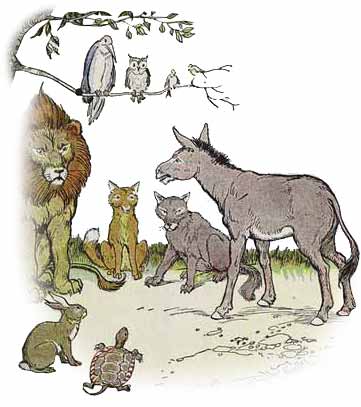
Once upon a time a severe plague raged among the animals. Many died, and those who lived were so ill, that they cared for neither food nor drink, and dragged themselves about listlessly. No longer could a fat young hen tempt Master Fox to dinner, nor a tender lamb rouse greedy Sir Wolf's appetite.
At last the Lion decided to call a council. When all the animals were gathered together he arose and said:
"Dear friends, I believe the gods have sent this plague upon us as a punishment for our sins. Therefore, the most guilty one of us must be offered in sacrifice. Perhaps we may thus obtain forgiveness and cure for all.
"I will confess all my sins first. I admit that I have been very greedy and have devoured many sheep. They had done me no harm. I have eaten goats and bulls and stags. To tell the truth, I even ate up a shepherd now and then.
"Now, if I am the most guilty, I am ready to be sacrificed. But I think it best that each one confess his sins as I have done. Then we can decide in all justice who is the most guilty."
"Your majesty," said the Fox, "you are too good. Can it be a crime to eat sheep, such stupid mutton heads? No, no, your majesty. You have done them great honor by eating them up.
"And so far as shepherds are concerned, we all know they belong to that puny race that pretends to be our masters."
All the animals applauded the Fox loudly. Then, though the Tiger, the Bear, the Wolf, and all the savage beasts recited the most wicked deeds, all were excused and made to appear very saint-like and innocent.
It was now the Ass's turn to confess.
"I remember," he said guiltily, "that one day as I was passing a field belonging to some priests, I was so tempted by the tender grass and my hunger, that I could not resist nibbling a bit of it. I had no right to do it, I admit—"
A great uproar among the beasts interrupted him. Here was the culprit who had brought misfortune on all of them! What a horrible crime it was to eat grass that belonged to someone else! It was enough to hang anyone for, much more an Ass.
Immediately they all fell upon him, the Wolf in the lead, and soon had made an end to him, sacrificing him to the gods then and there, and without the formality of an altar.
Moral: The weak are made to suffer for the misdeeds of the powerful.
动物与瘟疫 (中文翻译 拼音注音)
很久以前,动物世界里发生了一场十分严重的瘟疫。 许多动物都因此丧命,那些生还的动物也十分虚弱,甚至于饮食不思了,它们就这样无精打采地游荡着。 又肥又嫩的母鸡无法激起狐狸大师享用晚餐的念头,香嫩的羔羊也无法激起狼先生的胃口。
最后,狮子大王决定召开一次议会。当所有的动物都聚集在一起的时候,狮子站起来说道:
“亲爱的朋友们,我相信神之所以发动这场瘟疫,是为了对我们所犯的罪恶进行惩罚。因此,在我们当中,必须把恶贯满盈的那个祭祀给神。希望这样能够得到神的宽恕,并治愈大家。”
“首先由我来忏悔自己所有的罪过。我承认自己向来贪婪无度,吃掉了很多羔羊,尽管它们对我并无恶意。我还吃掉了很多山羊、牛、鹿。老实说,我偶尔也会吃掉牧羊人。”
“那么,如果我确实是罪恶最深的,我已经准备好了把自己祭祀给神。但是我希望,在场的各位,都能像我这样一一坦白。这样,我们就能十分公正地判决谁是罪大恶极。”
“陛下,” 狐狸大师说,“你太善良了。吃掉羊这种傻瓜一样的动物,怎么能算作是恶行呢?不算的,不算的,陛下。吃掉它们,是它们的殊荣。”
“至于牧羊人,我们都知道他们那一族其实是微不足道的,还以为能控制得了我们。”
狐狸的话赢得了动物们的阵阵掌声。然后,老虎、熊、狼等猛兽都一一例举了自己最恶劣的行径,却都被赦免了,并且还都看起来一副圣人般纯真的模样。
现在,轮到驴子忏悔了。
“我记得” 它愧疚地说,“有一天,我在经过一片属于牧师们的草地的时候,因为我太饿了,那片绿草又那么鲜嫩,我就忍不住偷吃了点。我知错了...”
野兽们对此一片哗然,让它不得不停下来。原来这就是给它们带来痛苦和折磨的罪魁祸首! 吃掉不属于自己的草,那可真是罪大恶极!任何犯下这种罪行的,都应当施以绞刑,哪怕它只是只驴!
动物们立马向驴扑去,领头的狼很快结果了它,并当场就把驴祭祀给了神,尽管连个正式的祭坛都没有。


About 关于
The Aesop Fables for Children 伊索寓言儿童故事全集 (图文英汉双语版) (this work), the english fables originally from The Aesop for Children: with Pictures by Milo Winter published by Rand, McNally & Co in 1919. Some of pictures come from Library of Congress. This work is considered to be in the public domain in the United States. The Aesop Fables for Children contains the text of selected fables, color pictures, video, and interactive animations, and will be enjoyed by readers of any age.
The Aesop Fables for Children are a collection of stories designed to teach moral lessons credited to Aesop, a Greek slave and story-teller thought to have lived between 620 and 560 BCE.
Aesop's fables are some of the most well known in the world and have been translated in multiple languages and become popular in dozens of cultures through the course of five centuries. They have been told and retold in a variety of media, from oral tradition to written storybooks to stage, film and animated cartoon versions—even in architecture. This page include translation to Simplified Chinese.
伊索寓言是一部世界上最早的寓言故事集,是世界文学史上流传最广的寓言故事之一。 本文包含伊索寓言故事英文原文和简体中文翻译(中英双语)。
