The Fox and the Crow 狐狸和乌鸦 (精美插图) 双语 拼音注音 伊索寓言
标签:伊索寓言 儿童故事集 中英对照翻译 双语故事 拼音注音
Last Update 最后更新: 2022-01-12
The Fox and the Crow (English)
Total Words: 275
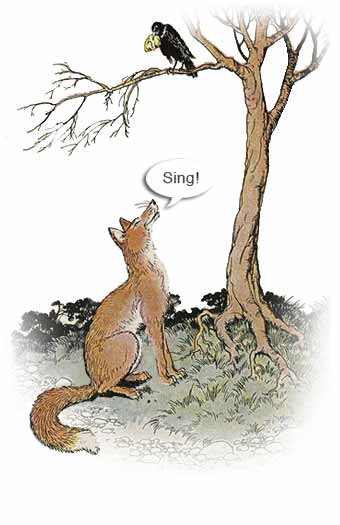
One bright morning as the Fox was following his sharp nose through the wood in search of a bite to eat, he saw a Crow on the limb of a tree overhead. This was by no means the first Crow the Fox had ever seen. What caught his attention this time and made him stop for a second look, was that the lucky Crow held a bit of cheese in her beak.
"No need to search any farther," thought sly Master Fox. "Here is a dainty bite for my breakfast."
Up he trotted to the foot of the tree in which the Crow was sitting, and looking up admiringly, he cried, "Good-morning, beautiful creature!"
The Crow, her head cocked on one side, watched the Fox suspiciously. But she kept her beak tightly closed on the cheese and did not return his greeting.
"What a charming creature she is!" said the Fox. "How her feathers shine! What a beautiful form and what splendid wings! Such a wonderful Bird should have a very lovely voice, since everything else about her is so perfect. Could she sing just one song, I know I should hail her Queen of Birds."
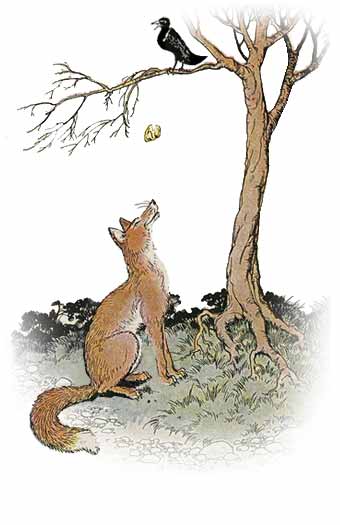
Listening to these flattering words, the Crow forgot all her suspicion, and also her breakfast. She wanted very much to be called Queen of Birds. So she opened her beak wide to utter her loudest caw, and down fell the cheese straight into the Fox's open mouth.
"Thank you," said Master Fox sweetly, as he walked off. "Though it is cracked, you have a voice sure enough. But where are your wits?"
Moral: The flatterer lives at the expense of those who will listen to him.
狐狸和乌鸦 (中文翻译 拼音注音)
一个晴朗的早晨,当狐狸跟随他灵敏的鼻子穿过树林寻找食物时,他看到一只乌鸦在头顶的树干上。这绝不是狐狸见过的第一只乌鸦。这次引起他注意并让他停下来多看一眼的,是幸运的乌鸦嘴里叼着一块奶酪。
“不用再找了,” 狡猾的狐狸大师想。 “我美味的早餐就在这里。”
他小跑到乌鸦所在的树脚下,抬头仰望,赞叹道:“早上好,美丽的小家伙!”
乌鸦歪着头,怀疑地看着狐狸。但她的喙紧紧地咬在奶酪上,没有回应狐狸的问候。
“她可真是太令人着迷了!”狐狸说。 “她的羽毛多么闪耀!她的身材多么苗条,多么灿烂的翅膀!如此美妙的鸟儿,应该有非常美妙的嗓音,因为她的一切都是如此完美。要是她能够哼唱一曲,只一曲,我就将拜她为万鸟之王。”
乌鸦听着这些讨好的话,忘记了她的所有怀疑,也忘记了她的早餐。她太想有人能够叫她一声万鸟之王了。于是她张大嘴,发出最响亮的叫声,而把奶酪直接掉进狐狸张开的嘴里。
“谢谢。” 狐狸大师走的时候温柔地说:“虽然你的嗓音有些沙哑,但好歹你还是能发出声音。只不过,你的智商在哪里呢?”


Relevant Fables 相关寓言故事
- 伊索寓言:The Fox and the Grapes 狐狸和葡萄
- 伊索寓言:The Crow and the Pitcher 乌鸦喝水
- 伊索寓言:The Wild Boar and the Fox 野猪和狐狸
- 伊索寓言:The Fox and the Stork 狐狸和鹤
- 伊索寓言:The Cock and the Fox 公鸡和狐狸
- 伊索寓言:The Fox and the Goat 狐狸和山羊
- 伊索寓言:The Fox and the Leopard 狐狸和豹子
- 伊索寓言:The Dog the Cock and the Fox 狗、公鸡和狐狸
- 伊索寓言:The Ass the Fox and the Lion 驴,狐狸和狮子
- 伊索寓言:The Lion the Bear and the Fox 狮子、熊和狐狸
- 伊索寓言:The Fox and the Lion 狐狸和狮子
- 伊索寓言:The Dogs and the Fox 狗和狐狸
- 伊索寓言:The Fox and the Crab 狐狸和螃蟹
- 伊索寓言:The Old Lion and the Fox 年迈的狮子和狐狸
- 伊索寓言:The Fox and the Hedgehog 狐狸与刺猬
- 伊索寓言:The Fox Without a Tail 断了尾巴的狐狸
- 伊索寓言:The Cat and the Fox 猫和狐狸
- 伊索寓言:The Fox and the Pheasants 狐狸和山鸡
- 伊索寓言:The Fox and the Monkey 狐狸和猴子
About 关于
The Aesop Fables for Children 伊索寓言儿童故事全集 (图文英汉双语版) (this work), the english fables originally from The Aesop for Children: with Pictures by Milo Winter published by Rand, McNally & Co in 1919. Some of pictures come from Library of Congress. This work is considered to be in the public domain in the United States. The Aesop Fables for Children contains the text of selected fables, color pictures, video, and interactive animations, and will be enjoyed by readers of any age.
The Aesop Fables for Children are a collection of stories designed to teach moral lessons credited to Aesop, a Greek slave and story-teller thought to have lived between 620 and 560 BCE.
Aesop's fables are some of the most well known in the world and have been translated in multiple languages and become popular in dozens of cultures through the course of five centuries. They have been told and retold in a variety of media, from oral tradition to written storybooks to stage, film and animated cartoon versions—even in architecture. This page include translation to Simplified Chinese.
伊索寓言是一部世界上最早的寓言故事集,是世界文学史上流传最广的寓言故事之一。 本文包含伊索寓言故事英文原文和简体中文翻译(中英双语)。
