Belling the Cat 猫颈系铃 (精美插图) 双语 拼音注音 伊索寓言
标签:伊索寓言 儿童故事集 中英对照翻译 双语故事 拼音注音
Last Update 最后更新: 2022-01-12
Belling the Cat (English)
Total Words: 206
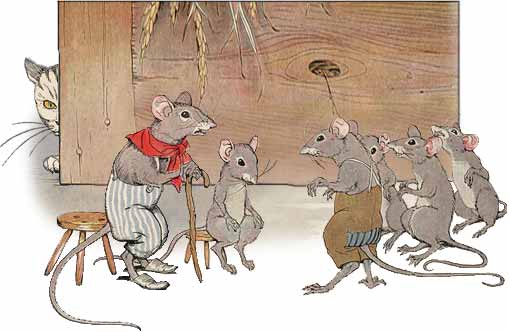
The Mice once called a meeting to decide on a plan to free themselves of their enemy, the Cat. At least they wished to find some way of knowing when she was coming, so they might have time to run away. Indeed, something had to be done, for they lived in such constant fear of her claws that they hardly dared stir from their dens by night or day.
Many plans were discussed, but none of them was thought good enough. At last a very young Mouse got up and said:
"I have a plan that seems very simple, but I know it will be successful.
All we have to do is to hang a bell about the Cat's neck. When we hear the bell ringing we will know immediately that our enemy is coming."
All the Mice were much surprised that they had not thought of such a plan before. But in the midst of the rejoicing over their good fortune, an old Mouse arose and said:
"I will say that the plan of the young Mouse is very good. But let me ask one question: Who will bell the Cat?"
Moral: It is one thing to say that something should be done, but quite a different matter to do it.
猫颈系铃 (中文翻译 拼音注音)
老鼠们曾经召集过一次会议来决定一项计划,以摆脱他们的敌人,猫。 至少,他们想找个办法知道它什么时候来,好让他们有时间逃跑。 确实,必须采取一些措施,因为他们一直生活在对她的爪子的恐惧之中,以至于他们几乎不敢在白天或黑夜从窝里动弹。
讨论了许多计划,但没有一个被认为足够好。 最后一只非常年轻的老鼠站起来说:
“我有一个看起来很简单的计划,但我知道它会成功。
我们所要做的就是在猫的脖子上挂一个铃铛。 当我们听到铃声响起时,我们会立即知道我们的敌人来了。”
所有的老鼠都很惊讶,他们之前没有想到这样的计划。 但就在为他们的好运而欢欣鼓舞的时候,一只老老鼠站了起来说:
“小老鼠的计划是很好。但让我问一个问题:谁来给猫系铃铛呢?”


Relevant Fables 相关寓言故事
- 伊索寓言:The Monkey and the Cat 猴子和猫
- 伊索寓言:The Rabbit the Weasel and the Cat 兔子、黄鼠狼和猫
- 伊索寓言:The Cat the Cock and the Young Mouse 猫、公鸡和小老鼠
- 伊索寓言:The Cat and the Birds 猫和鸟
- 伊索寓言:The Cat and the Fox 猫和狐狸
- 伊索寓言:The Cat and the Old Rat 猫和年迈的老鼠
About 关于
The Aesop Fables for Children 伊索寓言儿童故事全集 (图文英汉双语版) (this work), the english fables originally from The Aesop for Children: with Pictures by Milo Winter published by Rand, McNally & Co in 1919. Some of pictures come from Library of Congress. This work is considered to be in the public domain in the United States. The Aesop Fables for Children contains the text of selected fables, color pictures, video, and interactive animations, and will be enjoyed by readers of any age.
The Aesop Fables for Children are a collection of stories designed to teach moral lessons credited to Aesop, a Greek slave and story-teller thought to have lived between 620 and 560 BCE.
Aesop's fables are some of the most well known in the world and have been translated in multiple languages and become popular in dozens of cultures through the course of five centuries. They have been told and retold in a variety of media, from oral tradition to written storybooks to stage, film and animated cartoon versions—even in architecture. This page include translation to Simplified Chinese.
伊索寓言是一部世界上最早的寓言故事集,是世界文学史上流传最广的寓言故事之一。 本文包含伊索寓言故事英文原文和简体中文翻译(中英双语)。
