The Cat and the Old Rat 猫和年迈的老鼠 (精美插图) 双语 拼音注音 伊索寓言
标签:伊索寓言 儿童故事集 中英对照翻译 双语故事 拼音注音
Last Update 最后更新: 2022-01-12
The Cat and the Old Rat (English)
Total Words: 329
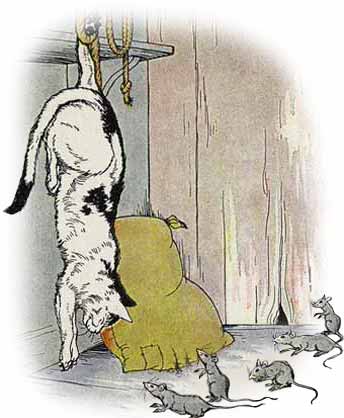
There was once a Cat who was so watchful, that a Mouse hardly dared show the tip of his whiskers for fear of being eaten alive. That Cat seemed to be everywhere at once with his claws all ready for a pounce. At last the Mice kept so closely to their dens, that the Cat saw he would have to use his wits well to catch one. So one day he climbed up on a shelf and hung from it, head downward, as if he were dead, holding himself up by clinging to some ropes with one paw.
When the Mice peeped out and saw him in that position, they thought he had been hung up there in punishment for some misdeed. Very timidly at first they stuck out their heads and sniffed about carefully. But as nothing stirred, all trooped joyfully out to celebrate the death of the Cat.
Just then the Cat let go his hold, and before the Mice recovered from their surprise, he had made an end of three or four.
Now the Mice kept more strictly at home than ever. But the Cat, who was still hungry for Mice, knew more tricks than one. Rolling himself in flour until he was covered completely, he lay down in the flour bin, with one eye open for the Mice.
Sure enough, the Mice soon began to come out. To the Cat it was almost as if he already had a plump young Mouse under his claws, when an old Rat, who had had much experience with Cats and traps, and had even lost a part of his tail to pay for it, sat up at a safe distance from a hole in the wall where he lived.
"Take care!" he cried. "That may be a heap of meal, but it looks to me very much like the Cat. Whatever it is, it is wisest to keep at a safe distance."
Moral: The wise do not let themselves be tricked a second time.
猫和年迈的老鼠 (中文翻译 拼音注音)
曾经有着一只非常机警的猫,老鼠们连一根胡须尖都不敢露出来,生怕被它抓住生吞了。 那只猫似乎无处不在,它的利爪随时准备着立马扑向它的猎物。 最后,老鼠们只好老老实实呆在它们的巢穴附近,而这只猫也很明白自己必须要利用好机智,才能够捕捉到一只老鼠了。 于是,有一天,这只猫就爬上了一个架子,头朝下地把自己挂起来,用一只爪子抓着绳子支撑着自己,就好像它已经死了一样。
当老鼠们从洞穴向外窥视,看见了猫的姿态,便以为是主人因为它犯了错而把它挂在那里惩罚它。 一开始,它们还小心翼翼地伸出头去,仔仔细细地嗅啊嗅。 但是,因为觉得没有什么值得担心的,老鼠们就全体涌出洞穴,欢天喜地地庆祝这只猫的死亡。
突然,这只猫松开了爪子,就在老鼠们从惊诧中回过神来之前,已经被猫结果了三四只。
至此,老鼠们比以前更加不敢出门了。 但是这只猫,仍然很想吃老鼠,而且它的伎俩可不止一个。 它在面粉里滚啊滚,直到自己完全被面粉覆盖,然后就躺在面粉桶里,只睁开一只眼睛,以待老鼠们的到来。
确信足够安全了,老鼠们很快又出洞了。 对这只猫来说,就好像它已经用爪子抓住了一只胖乎乎的小老鼠,突然,一只上了年纪的老鼠,它对猫和陷阱有着相当丰富的经验,甚至是以丢掉了它的一部分尾巴为代价,远远地站在它所生活的墙下的洞门口上。
“小心!”它喊叫道。 “那可能是一堆食物,但对我而言,看起来就像那只猫。 不管那是什么,保持安全距离总是十分明智的。”


Relevant Fables 相关寓言故事
- 伊索寓言:Belling the Cat 猫颈系铃
- 伊索寓言:The Town Mouse and the Country Mouse 城市老鼠和乡村老鼠
- 伊索寓言:The Lion and the Mouse 狮子和老鼠
- 伊索寓言:The Frog and the Mouse 青蛙和老鼠
- 伊索寓言:The Rat and the Elephant 老鼠和大象
- 伊索寓言:The Mice and the Weasels 老鼠和黄鼠狼
- 伊索寓言:The Monkey and the Cat 猴子和猫
- 伊索寓言:The Rabbit the Weasel and the Cat 兔子、黄鼠狼和猫
- 伊索寓言:The Cat the Cock and the Young Mouse 猫、公鸡和小老鼠
- 伊索寓言:The Mouse and the Weasel 老鼠和鼬
- 伊索寓言:The Cat and the Birds 猫和鸟
- 伊索寓言:The Cat and the Fox 猫和狐狸
About 关于
The Aesop Fables for Children 伊索寓言儿童故事全集 (图文英汉双语版) (this work), the english fables originally from The Aesop for Children: with Pictures by Milo Winter published by Rand, McNally & Co in 1919. Some of pictures come from Library of Congress. This work is considered to be in the public domain in the United States. The Aesop Fables for Children contains the text of selected fables, color pictures, video, and interactive animations, and will be enjoyed by readers of any age.
The Aesop Fables for Children are a collection of stories designed to teach moral lessons credited to Aesop, a Greek slave and story-teller thought to have lived between 620 and 560 BCE.
Aesop's fables are some of the most well known in the world and have been translated in multiple languages and become popular in dozens of cultures through the course of five centuries. They have been told and retold in a variety of media, from oral tradition to written storybooks to stage, film and animated cartoon versions—even in architecture. This page include translation to Simplified Chinese.
伊索寓言是一部世界上最早的寓言故事集,是世界文学史上流传最广的寓言故事之一。 本文包含伊索寓言故事英文原文和简体中文翻译(中英双语)。
