The Sheep and the Pig 绵羊和猪 (精美插图) 双语 拼音注音 伊索寓言
标签:伊索寓言 儿童故事集 中英对照翻译 双语故事 拼音注音
Last Update 最后更新: 2022-01-12
The Sheep and the Pig (English)
Total Words: 186
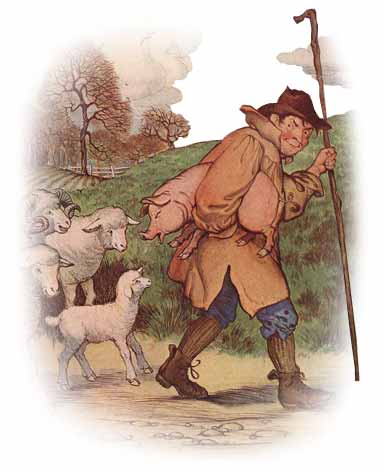
One day a shepherd discovered a fat Pig in the meadow where his Sheep were pastured. He very quickly captured the porker, which squealed at the top of its voice the moment the Shepherd laid his hands on it. You would have thought, to hear the loud squealing, that the Pig was being cruelly hurt. But in spite of its squeals and struggles to escape, the Shepherd tucked his prize under his arm and started off to the butcher's in the market place.
The Sheep in the pasture were much astonished and amused at the Pig's behavior, and followed the Shepherd and his charge to the pasture gate.
"What makes you squeal like that?" asked one of the Sheep. "The Shepherd often catches and carries off one of us. But we should feel very much ashamed to make such a terrible fuss about it like you do."
"That is all very well," replied the Pig, with a squeal and a frantic kick. "When he catches you he is only after your wool. But he wants my bacon! gree-ee-ee!"
Moral: It is easy to be brave when there is no danger.
绵羊和猪 (中文翻译 拼音注音)
有一天,牧羊人发现,在放羊的那片草地里有一只很肥的猪。他非常迅速地抓住了那头小肥猪,牧羊人刚一碰到它,它就鼓足了劲儿尖叫。听到这刺耳的尖叫声,你可能会以为,这小肥猪被野蛮地弄伤了。但是,尽管想要逃走的它一边尖叫,一边挣扎,牧羊人把它紧紧夹在自己的腋下,朝着集市上的屠夫家出发了。
草地里的绵羊对小肥猪的反应感到又惊讶又好笑,它们跟着牧羊人,并在他的引导下来到了草场大门前。
“你为什么要那样尖叫呢?” 其中一只绵羊问道。“牧羊人也经常这样抓着带走我们。但是,像你那样又吵又闹,我们就会感到非常羞愧。”
“那可真是好极了,” 小肥猪又叫又踢地答道。“他抓你,是为了你的毛!他抓我,却是要吃我的肉!”


Relevant Fables 相关寓言故事
- 伊索寓言:The Wild Boar and the Fox 野猪和狐狸
- 伊索寓言:The Wolf in Sheep's Clothing 披着羊皮的狼
- 伊索寓言:The Wolf and the Kid 狼和小羊
- 伊索寓言:The Kid and the Wolf 小羊和狼
- 伊索寓言:The Wolf and the Lamb 狼和小羊
- 伊索寓言:The Wolf and the Sheep 狼和羊
- 伊索寓言:The Stag the Sheep and the Wolf 鹿、羊和狼
About 关于
The Aesop Fables for Children 伊索寓言儿童故事全集 (图文英汉双语版) (this work), the english fables originally from The Aesop for Children: with Pictures by Milo Winter published by Rand, McNally & Co in 1919. Some of pictures come from Library of Congress. This work is considered to be in the public domain in the United States. The Aesop Fables for Children contains the text of selected fables, color pictures, video, and interactive animations, and will be enjoyed by readers of any age.
The Aesop Fables for Children are a collection of stories designed to teach moral lessons credited to Aesop, a Greek slave and story-teller thought to have lived between 620 and 560 BCE.
Aesop's fables are some of the most well known in the world and have been translated in multiple languages and become popular in dozens of cultures through the course of five centuries. They have been told and retold in a variety of media, from oral tradition to written storybooks to stage, film and animated cartoon versions—even in architecture. This page include translation to Simplified Chinese.
伊索寓言是一部世界上最早的寓言故事集,是世界文学史上流传最广的寓言故事之一。 本文包含伊索寓言故事英文原文和简体中文翻译(中英双语)。
