Mercury and the Woodman 金斧头和樵夫 (精美插图) 双语 拼音注音 伊索寓言
标签:伊索寓言 儿童故事集 中英对照翻译 双语故事 拼音注音
Last Update 最后更新: 2022-01-12
Mercury and the Woodman (English)
Total Words: 426
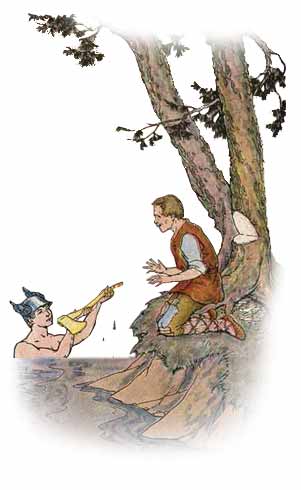
A poor Woodman was cutting down a tree near the edge of a deep pool in the forest. It was late in the day and the Woodman was tired. He had been working since sunrise and his strokes were not so sure as they had been early that morning. Thus it happened that the axe slipped and flew out of his hands into the pool.
The Woodman was in despair. The axe was all he possessed with which to make a living, and he had not money enough to buy a new one. As he stood wringing his hands and weeping, the god Mercury suddenly appeared and asked what the trouble was. The Woodman told what had happened, and straightway the kind Mercury dived into the pool. When he came up again he held a wonderful golden axe.
"Is this your axe?" Mercury asked the Woodman.
"No," answered the honest Woodman, "that is not my axe."
Mercury laid the golden axe on the bank and sprang back into the pool. This time he brought up an axe of silver, but the Woodman declared again that his axe was just an ordinary one with a wooden handle.
Mercury dived down for the third time, and when he came up again he had the very axe that had been lost.
The poor Woodman was very glad that his axe had been found and could not thank the kind god enough. Mercury was greatly pleased with the Woodman's honesty.
"I admire your honesty," he said, "and as a reward you may have all three axes, the gold and the silver as well as your own."
The happy Woodman returned to his home with his treasures, and soon the story of his good fortune was known to everybody in the village. Now there were several Woodmen in the village who believed that they could easily win the same good fortune. They hurried out into the woods, one here, one there, and hiding their axes in the bushes, pretended they had lost them. Then they wept and wailed and called on Mercury to help them.
And indeed, Mercury did appear, first to this one, then to that. To each one he showed an axe of gold, and each one eagerly claimed it to be the one he had lost. But Mercury did not give them the golden axe. Oh no! Instead he gave them each a hard whack over the head with it and sent them home. And when they returned next day to look for their own axes, they were nowhere to be found.
Moral: Honesty is the best policy.
金斧头和樵夫 (中文翻译 拼音注音)
一天,有一个贫苦的樵夫在森林里砍树,这棵树的旁边是一个水很深的湖泊。当时天色也晚了,这个樵夫也累了。他从一大早就在忙碌,以至于这会儿他的精力已不如早晨那般充沛。突然,他的斧头从手中滑落、掉进了湖里。
这个樵夫陷入了绝望。那把斧头是他唯一的谋生工具,而且他也没有足够的钱去买一把新的。就在他站着扭绞着双手不停地哭泣之时,墨丘利(罗马神话神)突然出现了,并问他遇到了什么麻烦事。樵夫把刚刚发生的事情告诉了墨丘利,墨丘利听后就立马跳进了湖里。当神使浮出水面时,他的手里握着一把很神气的金斧子。
“这是你的斧头吗?”墨丘利对樵夫问道。
“不是的,”樵夫诚实地答道,“这不是我的斧头。”
墨丘利把这金斧子放在岸边,转头又跳回了湖里。这一次,他带了一把银斧头上来,但是樵夫再次解释说,他的斧头只是一把普通的木柄斧头。
墨丘利第三次跳进了湖里,当他浮出水面时,他的手里拿着的正是樵夫所丢的那一把。
那贫苦的樵夫对此非常高兴,他的斧头终于失而复得,但是他却不知道怎么感谢神使才好。神使墨丘利非常赏识樵夫的诚实。
“我很敬佩你的诚实,”神使说,“作为回报,你可以拥有三柄斧头,就是说那把金斧头和银斧头也是你的了。”
樵夫带着他的宝贝高高兴兴地回家了,这天上掉馅饼的故事很快传遍了村子。村子里其他的几个樵夫听说后,也相信自己能够遇到这等好事。于是,他们急匆匆地跑进那片林子,东一个、西一个地把自己斧头藏进灌木丛中,并假装他们也弄丢了自己的斧头。接着他们就哭啊哭,呼唤着神使墨丘利来帮助他们。
果然,墨丘利的确出现了,一个挨一个的问了呼唤他的缘由。 接着,墨丘利对每个樵夫都展示了一把金斧头,樵夫们都急切地坚称这就是他们弄丢的斧头。 但是墨丘利却并没有把这把金斧头交给他们。 噢,不!相反地,他用这把金斧头在樵夫们的头上狠狠地敲打了一下,并把他们都送回了家。 第二天,当这几个樵夫返回林子里去寻找自己的斧头之时,却发现根本找不到了。


Relevant Fables 相关寓言故事
About 关于
The Aesop Fables for Children 伊索寓言儿童故事全集 (图文英汉双语版) (this work), the english fables originally from The Aesop for Children: with Pictures by Milo Winter published by Rand, McNally & Co in 1919. Some of pictures come from Library of Congress. This work is considered to be in the public domain in the United States. The Aesop Fables for Children contains the text of selected fables, color pictures, video, and interactive animations, and will be enjoyed by readers of any age.
The Aesop Fables for Children are a collection of stories designed to teach moral lessons credited to Aesop, a Greek slave and story-teller thought to have lived between 620 and 560 BCE.
Aesop's fables are some of the most well known in the world and have been translated in multiple languages and become popular in dozens of cultures through the course of five centuries. They have been told and retold in a variety of media, from oral tradition to written storybooks to stage, film and animated cartoon versions—even in architecture. This page include translation to Simplified Chinese.
伊索寓言是一部世界上最早的寓言故事集,是世界文学史上流传最广的寓言故事之一。 本文包含伊索寓言故事英文原文和简体中文翻译(中英双语)。
