The Bees Wasps and the Hornet 蜜蜂、黄蜂和大黄蜂 (精美插图) 双语 拼音注音 伊索寓言
标签:伊索寓言 儿童故事集 中英对照翻译 双语故事 拼音注音
Last Update 最后更新: 2022-01-12
The Bees Wasps and the Hornet (English)
Total Words: 297
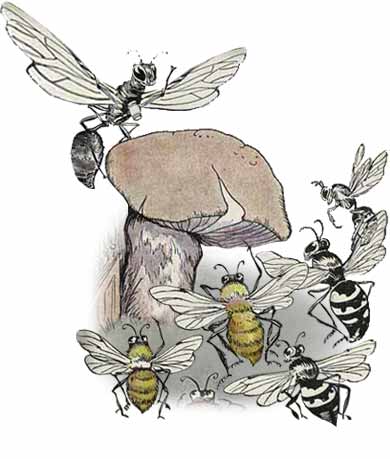
A store of honey had been found in a hollow tree, and the Wasps declared positively that it belonged to them. The Bees were just as sure that the treasure was theirs. The argument grew very pointed, and it looked as if the affair could not be settled without a battle, when at last, with much good sense, they agreed to let a judge decide the matter. So they brought the case before the Hornet, justice of the peace in that part of the woods.
When the Judge called the case, witnesses declared that they had seen certain winged creatures in the neighborhood of the hollow tree, who hummed loudly, and whose bodies were striped, yellow and black, like Bees.
Counsel for the Wasps immediately insisted that this description fitted his clients exactly.
Such evidence did not help Judge Hornet to any decision, so he adjourned court for six weeks to give him time to think it over. When the case came up again, both sides had a large number of witnesses. An Ant was first to take the stand, and was about to be cross-examined, when a wise old Bee addressed the Court.
"Your honor," he said, "the case has now been pending for six weeks. If it is not decided soon, the honey will not be fit for anything. I move that the Bees and the Wasps be both instructed to build a honey comb. Then we shall soon see to whom the honey really belongs."
The Wasps protested loudly. Wise Judge Hornet quickly understood why they did so: They knew they could not build a honey comb and fill it with honey.
"It is clear," said the Judge, "who made the comb and who could not have made it. The honey belongs to the Bees."
Moral: Ability proves itself by deeds.
蜜蜂、黄蜂和大黄蜂 (中文翻译 拼音注音)
一棵空心树里被发现贮藏着蜂蜜,黄蜂坚称这些蜂蜜是属于它们的。蜜蜂也声明信这珍酿是自己的。 双方之间的争论变得越来越激烈,那阵势看起来不打一架是解决不了这个问题的,最后它们非常明智地一致同意,让一个法官来解决这个麻烦。 于是,它们就把这个案子交到了大黄蜂面前,大黄蜂可是那一带最为公正的法官,平息了不少争端。
法官开始审理这个案子的时候,证人们声称,在那棵空心树附近确实住着某种会飞的动物,这些动物会发出很大的嗡嗡声,而且它们有着条纹、黄色和黑色的肢体,就跟蜜蜂是的。
黄蜂的律师立马坚称,这描述完全符合它的委托人。
这样的证据根本不能帮助大黄蜂法官做出任何决断,于是它宣布休庭六周好让它有时间仔细想想。 当再次开庭审理这个案子的时候,双方都有了很多证人。 蚂蚁第一个出来作证,正当他准备接受双方律师盘问的时候,一只聪明的老蜜蜂在庭上发了言。
“法官大人” 它说,“这案子已经被搁置了六周了,要是再不做出决断,那些蜂蜜就没什么用了。我提议,让蜜蜂和黄蜂各自去建造一个蜂窝。那么,我们将很快知晓,这些蜂蜜到底是谁的了。”
黄蜂们对此强烈抗议。 而聪明的大黄蜂法官很快就明白了它们为什么抗议得这么激烈:黄蜂很清楚自己根本建造不出能够装蜂蜜的蜂窝。
“很显然” 法官说,“谁有能力建造这种蜂窝是十分明显的。这蜂蜜是属于蜜蜂的。”


Relevant Fables 相关寓言故事
About 关于
The Aesop Fables for Children 伊索寓言儿童故事全集 (图文英汉双语版) (this work), the english fables originally from The Aesop for Children: with Pictures by Milo Winter published by Rand, McNally & Co in 1919. Some of pictures come from Library of Congress. This work is considered to be in the public domain in the United States. The Aesop Fables for Children contains the text of selected fables, color pictures, video, and interactive animations, and will be enjoyed by readers of any age.
The Aesop Fables for Children are a collection of stories designed to teach moral lessons credited to Aesop, a Greek slave and story-teller thought to have lived between 620 and 560 BCE.
Aesop's fables are some of the most well known in the world and have been translated in multiple languages and become popular in dozens of cultures through the course of five centuries. They have been told and retold in a variety of media, from oral tradition to written storybooks to stage, film and animated cartoon versions—even in architecture. This page include translation to Simplified Chinese.
伊索寓言是一部世界上最早的寓言故事集,是世界文学史上流传最广的寓言故事之一。 本文包含伊索寓言故事英文原文和简体中文翻译(中英双语)。
