The Cat the Cock and the Young Mouse 猫、公鸡和小老鼠 (精美插图) 双语 拼音注音 伊索寓言
标签:伊索寓言 儿童故事集 中英对照翻译 双语故事 拼音注音
Last Update 最后更新: 2022-01-12
The Cat the Cock and the Young Mouse (English)
Total Words: 353
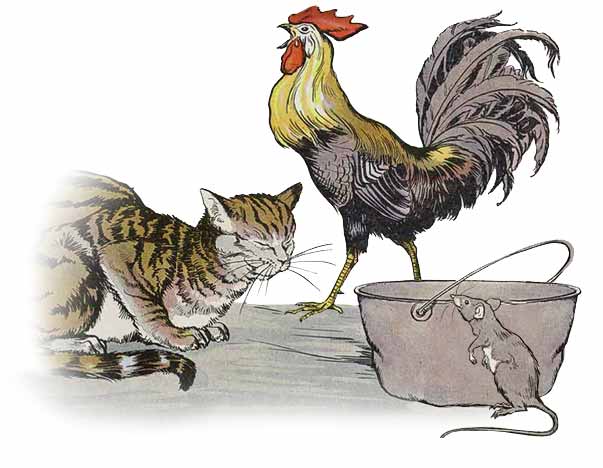
A very young Mouse, who had never seen anything of the world, almost came to grief the very first time he ventured out. And this is the story he told his mother about his adventures.
"I was strolling along very peaceably when, just as I turned the corner into the next yard, I saw two strange creatures. One of them had a very kind and gracious look, but the other was the most fearful monster you can imagine. You should have seen him.
"On top of his head and in front of his neck hung pieces of raw red meat. He walked about restlessly, tearing up the ground with his toes, and beating his arms savagely against his sides. The moment he caught sight of me he opened his pointed mouth as if to swallow me, and then he let out a piercing roar that frightened me almost to death."
Can you guess who it was that our young Mouse was trying to describe to his mother? It was nobody but the Barnyard Cock and the first one the little Mouse had ever seen.
"If it had not been for that terrible monster," the Mouse went on, "I should have made the acquaintance of the pretty creature, who looked so good and gentle. He had thick, velvety fur, a meek face, and a look that was very modest, though his eyes were bright and shining. As he looked at me he waved his fine long tail and smiled.
"I am sure he was just about to speak to me when the monster I have told you about let out a screaming yell, and I ran for my life."
"My son," said the Mother Mouse, "that gentle creature you saw was none other than the Cat. Under his kindly appearance, he bears a grudge against every one of us. The other was nothing but a bird who wouldn't harm you in the least. As for the Cat, he eats us. So be thankful, my child, that you escaped with your life, and, as long as you live, never judge people by their looks."
Moral: Do not trust alone to outward appearances.
猫、公鸡和小老鼠 (中文翻译 拼音注音)
一只从未见过世面的小老鼠,经历第一次悲伤的冒险。这是他告诉他母亲关于他的冒险经历的故事。
“我正悠闲地散步,转过拐角进入隔壁院子的时候,看到了两个奇怪的动物。其中一个看起来非常和蔼可亲,但另一个是你能想象到的最可怕的怪物。你应该见过它。
“它的头顶和脖子前挂着一块生的红色的肉。他走来走去,用脚尖撑着地面,双臂使劲地拍打着自己的身体。它看到我的瞬间,它张开的嘴好像要把我吞下去,然后他发出一声刺耳的尖叫,把我吓得几乎要死。”
你能猜出我们的小老鼠想向他妈妈描述的是谁吗?它是小老鼠见到的第一只公鸡。
“要不是那个可怕的怪物,” 小老鼠继续说,“我早就认识了一个漂亮的动物,它看起来如此善良和温柔。它有厚厚的天鹅绒般的皮毛,一张温顺的脸,和看起来很谦虚的样子,虽然他的眼睛明亮而闪亮。它看着我,摇摆着它细长的尾巴,微笑着。
“它正要跟我说话时,碰巧那个怪物发出尖叫声,把我吓跑了。”
“我的儿子,”老鼠妈妈说,“你看到的那个温柔的生物正是猫。在它和蔼的外表下,它对我们每个老鼠都怀有怨恨。另一个只不过是一只不会伤害你的鸟。至于猫,它吃我们。谢天谢他,我的孩子,你逃离了生命危险,只要你活着,永远不要以他们的外表判断人。”


Relevant Fables 相关寓言故事
- 伊索寓言:Belling the Cat 猫颈系铃
- 伊索寓言:The Town Mouse and the Country Mouse 城市老鼠和乡村老鼠
- 伊索寓言:The Lion and the Mouse 狮子和老鼠
- 伊索寓言:The Cock and the Fox 公鸡和狐狸
- 伊索寓言:The Frog and the Mouse 青蛙和老鼠
- 伊索寓言:The Dog the Cock and the Fox 狗、公鸡和狐狸
- 伊索寓言:The Rat and the Elephant 老鼠和大象
- 伊索寓言:The Cock and the Jewel 公鸡和宝石
- 伊索寓言:The Mice and the Weasels 老鼠和黄鼠狼
- 伊索寓言:The Monkey and the Cat 猴子和猫
- 伊索寓言:The Rabbit the Weasel and the Cat 兔子、黄鼠狼和猫
- 伊索寓言:The Mouse and the Weasel 老鼠和鼬
- 伊索寓言:The Cat and the Birds 猫和鸟
- 伊索寓言:The Cat and the Fox 猫和狐狸
- 伊索寓言:The Cat and the Old Rat 猫和年迈的老鼠
About 关于
The Aesop Fables for Children 伊索寓言儿童故事全集 (图文英汉双语版) (this work), the english fables originally from The Aesop for Children: with Pictures by Milo Winter published by Rand, McNally & Co in 1919. Some of pictures come from Library of Congress. This work is considered to be in the public domain in the United States. The Aesop Fables for Children contains the text of selected fables, color pictures, video, and interactive animations, and will be enjoyed by readers of any age.
The Aesop Fables for Children are a collection of stories designed to teach moral lessons credited to Aesop, a Greek slave and story-teller thought to have lived between 620 and 560 BCE.
Aesop's fables are some of the most well known in the world and have been translated in multiple languages and become popular in dozens of cultures through the course of five centuries. They have been told and retold in a variety of media, from oral tradition to written storybooks to stage, film and animated cartoon versions—even in architecture. This page include translation to Simplified Chinese.
伊索寓言是一部世界上最早的寓言故事集,是世界文学史上流传最广的寓言故事之一。 本文包含伊索寓言故事英文原文和简体中文翻译(中英双语)。
