The Wolf and the Kid 狼和小羊 (精美插图) 双语 拼音注音 伊索寓言
标签:伊索寓言 儿童故事集 中英对照翻译 双语故事 拼音注音
Last Update 最后更新: 2022-01-12
The Wolf and the Kid (English)
Total Words: 280
There was once a little Kid whose growing horns made him think he was a grown-up Billy Goat and able to take care of himself. So one evening when the flock started home from the pasture and his mother called, the Kid paid no heed and kept right on nibbling the tender grass. A little later when he lifted his head, the flock was gone.
He was all alone. The sun was sinking. Long shadows came creeping over the ground. A chilly little wind came creeping with them making scary noises in the grass. The Kid shivered as he thought of the terrible Wolf. Then he started wildly over the field, bleating for his mother. But not half-way, near a clump of trees, there was the Wolf!
The Kid knew there was little hope for him.
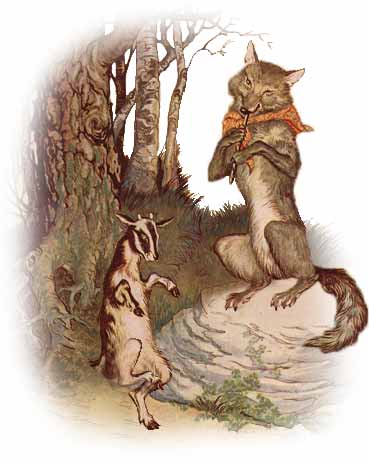
"Please, Mr. Wolf," he said trembling, "I know you are going to eat me. But first please pipe me a tune, for I want to dance and be merry as long as I can."
The Wolf liked the idea of a little music before eating, so he struck up a merry tune and the Kid leaped and frisked gaily.
Meanwhile, the flock was moving slowly homeward. In the still evening air the Wolf's piping carried far. The Shepherd Dogs pricked up their ears. They recognized the song the Wolf sings before a feast, and in a moment they were racing back to the pasture. The Wolf's song ended suddenly, and as he ran, with the Dogs at his heels, he called himself a fool for turning piper to please a Kid, when he should have stuck to his butcher's trade.
Moral: Do not let anything turn you from your purpose
狼和小羊 (中文翻译 拼音注音)
从前有一只小羊,随着他的羊角不断地长大,他以为自己已经是大人,可以自己照顾自己了。于是有一天,当羊群在草原上吃完草,准备回家的时候,他的妈妈叫他跟上,但是他不听,继续低头吃着草。过了一会儿,当他抬起头的时候,发现大家都走了。
此时他自己一个人孤孤单单,而太阳快要下山了。周围的景物在地上悄悄地投下了长长的影子,伴随着一阵阴风,把四周的草吹得沙沙作响,十分吓人。此时小羊想起了可怕的大灰狼,害怕得瑟瑟发抖。于是他开始大声地叫妈妈:“咩——,咩——......”。但是就在不远处的树丛中,潜伏着一只狼!
小羊知道自己这次凶多吉少了。
“拜托了,狼先生,”小羊颤抖着哀求道,“我知道你将要吃掉我。但是,在吃我之前请先给我吹奏一首曲子,因为我希望在被吃掉之前可以尽可能地开心起舞。”
狼很喜欢餐前听点音乐这个主意,于是他开始吹奏一个欢快的小调,小羊闻声便愉快地跳起舞来。
同时,羊群正在慢慢地往家的方向走。在这个宁静的傍晚,狼的笛声传到了很远很远的地方。牧羊犬们支起了耳朵。他们听出了这是狼在开始享受大餐之前会唱的歌, 于是他们立刻赶回草原。突然狼停止了吹奏,拔腿就跑,因为牧羊犬们正在他身后追赶他呢。他边跑边骂自己真是一个笨蛋,居然吹笛来逗一个小孩子开心,早知道 他就一口吃掉它算了。


Relevant Fables 相关寓言故事
- 伊索寓言:The Wolf and the Crane 狼和鹤
- 伊索寓言:The Wolf in Sheep's Clothing 披着羊皮的狼
- 伊索寓言:The Mother and the Wolf 母亲和狼
- 伊索寓言:The Kid and the Wolf 小羊和狼
- 伊索寓言:The Shepherd Boy and the Wolf 狼来了
- 伊索寓言:The Sheep and the Pig 绵羊和猪
- 伊索寓言:The Wolf and His Shadow 狼和他的影子
- 伊索寓言:The Wolf and the Lamb 狼和小羊
- 伊索寓言:The Wolf and the Sheep 狼和羊
- 伊索寓言:The Wolf and the Lion 狼和狮子
- 伊索寓言:The Wolf and the Lean Dog 狼和瘦狗
- 伊索寓言:The Wolf and the Ass 狼和驴
- 伊索寓言:The Wolf and the Goat 狼和山羊
- 伊索寓言:The Wolf and the Shepherd 狼和牧羊人
- 伊索寓言:The Wolf and the Shepherd 狼和牧羊人
- 伊索寓言:The Wolf and the House Dog 狼和家犬
- 伊索寓言:The Stag the Sheep and the Wolf 鹿、羊和狼
About 关于
The Aesop Fables for Children 伊索寓言儿童故事全集 (图文英汉双语版) (this work), the english fables originally from The Aesop for Children: with Pictures by Milo Winter published by Rand, McNally & Co in 1919. Some of pictures come from Library of Congress. This work is considered to be in the public domain in the United States. The Aesop Fables for Children contains the text of selected fables, color pictures, video, and interactive animations, and will be enjoyed by readers of any age.
The Aesop Fables for Children are a collection of stories designed to teach moral lessons credited to Aesop, a Greek slave and story-teller thought to have lived between 620 and 560 BCE.
Aesop's fables are some of the most well known in the world and have been translated in multiple languages and become popular in dozens of cultures through the course of five centuries. They have been told and retold in a variety of media, from oral tradition to written storybooks to stage, film and animated cartoon versions—even in architecture. This page include translation to Simplified Chinese.
伊索寓言是一部世界上最早的寓言故事集,是世界文学史上流传最广的寓言故事之一。 本文包含伊索寓言故事英文原文和简体中文翻译(中英双语)。
