The Shepherd Boy and the Wolf 狼来了 (精美插图) 双语 拼音注音 伊索寓言
标签:伊索寓言 儿童故事集 中英对照翻译 双语故事 拼音注音
Last Update 最后更新: 2022-01-12
The Shepherd Boy and the Wolf (English)
Total Words: 279
A Shepherd Boy tended his master's Sheep near a dark forest not far from the village. Soon he found life in the pasture very dull. All he could do to amuse himself was to talk to his dog or play on his shepherd's pipe.
One day as he sat watching the Sheep and the quiet forest, and thinking what he would do should he see a Wolf, he thought of a plan to amuse himself.
His Master had told him to call for help should a Wolf attack the flock, and the Villagers would drive it away. So now, though he had not seen anything that even looked like a Wolf, he ran toward the village shouting at the top of his voice, "Wolf! Wolf!"
As he expected, the Villagers who heard the cry dropped their work and ran in great excitement to the pasture. But when they got there they found the Boy doubled up with laughter at the trick he had played on them.
A few days later the Shepherd Boy again shouted, "Wolf! Wolf!" Again the Villagers ran to help him, only to be laughed at again.
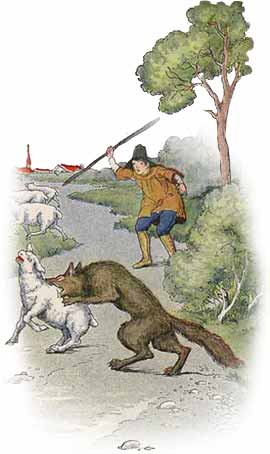
Then one evening as the sun was setting behind the forest and the shadows were creeping out over the pasture, a Wolf really did spring from the underbrush and fall upon the Sheep.
In terror the Boy ran toward the village shouting "Wolf! Wolf!" But though the Villagers heard the cry, they did not run to help him as they had before. "He cannot fool us again," they said.
The Wolf killed a great many of the Boy's sheep and then slipped away into the forest.
Moral: Liars are not believed even when they speak the truth.
狼来了 (中文翻译 拼音注音)
从前有一个牧童带他雇主的羊到村庄附近的森林周围吃草。很快他就对放牧感到厌烦了,因为那里唯一的娱乐就是跟他的狗说话或者吹一下他的牧笛。
有一天,他看着羊群和森林,想着万一他看见狼了,应该怎么办才好。这时他想到了一个有意思的点子。
他的雇主告诉他,万一有狼来袭击羊群的话,就大声叫人来帮忙,村民会来把狼赶跑的。尽管他现在并没有看见任何狼的踪迹,但是他跑向村庄,边喊道“狼来了!狼来了!”
正如他料想的那样,村民们一听见他的呼喊,立马放下手中的活,激动地跑到草地,但只看见牧童为自己的恶作剧得逞而大笑着。
几天以后牧童又大叫“狼来了!狼来了!”村民又跑来帮忙,但是发现这又是牧童恶作剧。
一天傍晚,夕阳西下,树影婆娑,一只狼从灌木丛中窜出来,猛地扑向羊群。
牧童害怕极了,一边跑向村庄一边大声喊“狼来了!狼来了!”虽然村民听见了牧童的求救,但是他们都没有像之前那样去帮忙。“这次我们不会再上当了。”村民说。
狼在杀死了许多羊以后,又溜回到森林去了。


Relevant Fables 相关寓言故事
- 伊索寓言:The Wolf and the Crane 狼和鹤
- 伊索寓言:The Wolf in Sheep's Clothing 披着羊皮的狼
- 伊索寓言:The Mother and the Wolf 母亲和狼
- 伊索寓言:The Wolf and the Kid 狼和小羊
- 伊索寓言:The Boy and the Filberts 男孩和榛子
- 伊索寓言:The Kid and the Wolf 小羊和狼
- 伊索寓言:The Wolf and His Shadow 狼和他的影子
- 伊索寓言:The Boys and the Frogs 男孩和青蛙
- 伊索寓言:The Wolf and the Lamb 狼和小羊
- 伊索寓言:The Wolf and the Sheep 狼和羊
- 伊索寓言:The Wolf and the Lion 狼和狮子
- 伊索寓言:The Wolf and the Lean Dog 狼和瘦狗
- 伊索寓言:The Wolf and the Ass 狼和驴
- 伊索寓言:The Wolf and the Goat 狼和山羊
- 伊索寓言:The Wolf and the Shepherd 狼和牧羊人
- 伊索寓言:The Wolf and the Shepherd 狼和牧羊人
- 伊索寓言:The Wolf and the House Dog 狼和家犬
- 伊索寓言:The Boy and the Nettle 男孩和荨麻
- 伊索寓言:The Stag the Sheep and the Wolf 鹿、羊和狼
About 关于
The Aesop Fables for Children 伊索寓言儿童故事全集 (图文英汉双语版) (this work), the english fables originally from The Aesop for Children: with Pictures by Milo Winter published by Rand, McNally & Co in 1919. Some of pictures come from Library of Congress. This work is considered to be in the public domain in the United States. The Aesop Fables for Children contains the text of selected fables, color pictures, video, and interactive animations, and will be enjoyed by readers of any age.
The Aesop Fables for Children are a collection of stories designed to teach moral lessons credited to Aesop, a Greek slave and story-teller thought to have lived between 620 and 560 BCE.
Aesop's fables are some of the most well known in the world and have been translated in multiple languages and become popular in dozens of cultures through the course of five centuries. They have been told and retold in a variety of media, from oral tradition to written storybooks to stage, film and animated cartoon versions—even in architecture. This page include translation to Simplified Chinese.
伊索寓言是一部世界上最早的寓言故事集,是世界文学史上流传最广的寓言故事之一。 本文包含伊索寓言故事英文原文和简体中文翻译(中英双语)。
